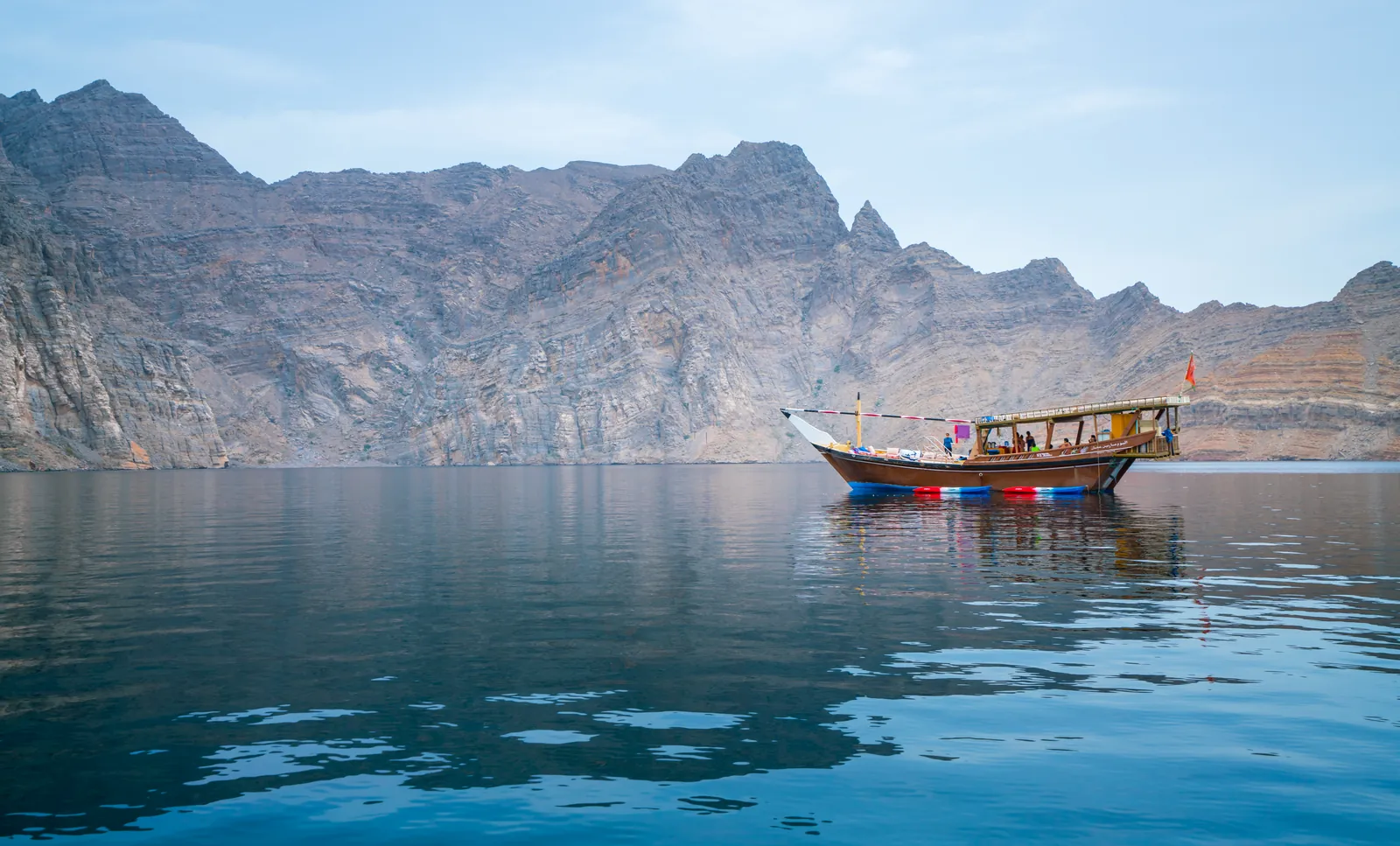
The dhow feels less like a boat and more like a slow-moving viewing platform. As it pushes away from the harbour, the Hajar Mountains rise straight from the water, their brown and grey flanks folding into a coastline of bays, fjords and islands. The engine settles into a steady thrum, and the crew begin laying out tanks and fins along the deck rails. You notice how the air changes as the first narrow inlet opens ahead, cooler and faintly scented with salt and diesel.
Musandam is one of the few places in the Gulf where the dive day begins with a genuine sense of passage. The boat ride is not a transfer to be endured but part of the rhythm. Old trading dhows once worked these waters for pearls and fish, and the modern dive dhows still carry that unhurried character. Over the next few hours, the landscape does half the work of preparation, settling divers into a quieter pace before they ever roll backwards off the side.
The shape of a full dive day
A typical guided day out of Khasab follows a pattern that suits the peninsula’s geography. Many trips depart around ten in the morning after a short briefing at the harbour office. The boat runs to sites with names that sound like a local chart come to life, including Abu Sir Island, Al Khayal Island, Bu Rashid Island and Khor Farda, which is also called Baby Beach. Each site sits inside the fjord system, sheltered from open water and dive-able through much of the year.
Between dives, lunch appears from the galley, often rice, grilled chicken, flatbread and fresh fruit, with tea and coffee kept hot in flasks. The crew manage the heavy work, swapping tanks and helping with kit, which leaves divers free to watch the cliffs slide past. A second dive follows in the early afternoon, usually on a different reef or wall. By four o’clock the boat is heading back toward Khasab, with the sun dropping behind the ridge and the deck hosed clean of salt.
Some operators run faster speedboat versions of the same schedule, which can feel more direct but less atmospheric. The dhow option generally allows more space to move, stretch and dry off. If you are self-driving from the UAE, the morning report time in Khasab is commonly around nine thirty, so an early border crossing is part of the planning. Bring your passport, a small dry bag for electronics, and enough patience for the occasional queue.
What the underwater world actually holds
The reefs here are built on a foundation of hard and soft corals that have survived cycles of heat and storm. Brain corals grow as stony mounds with grooved surfaces that look uncannily like a human brain, and in Musandam’s warm water they can reach six feet tall over centuries. Purple whip corals and raspberry corals add sharp colour to the walls, while Acropora branches form dense thickets in places. The same Acropora suffered heavy losses off Dubai and Abu Dhabi during high temperatures between 1996 and 1998, which makes its presence here feel significant.
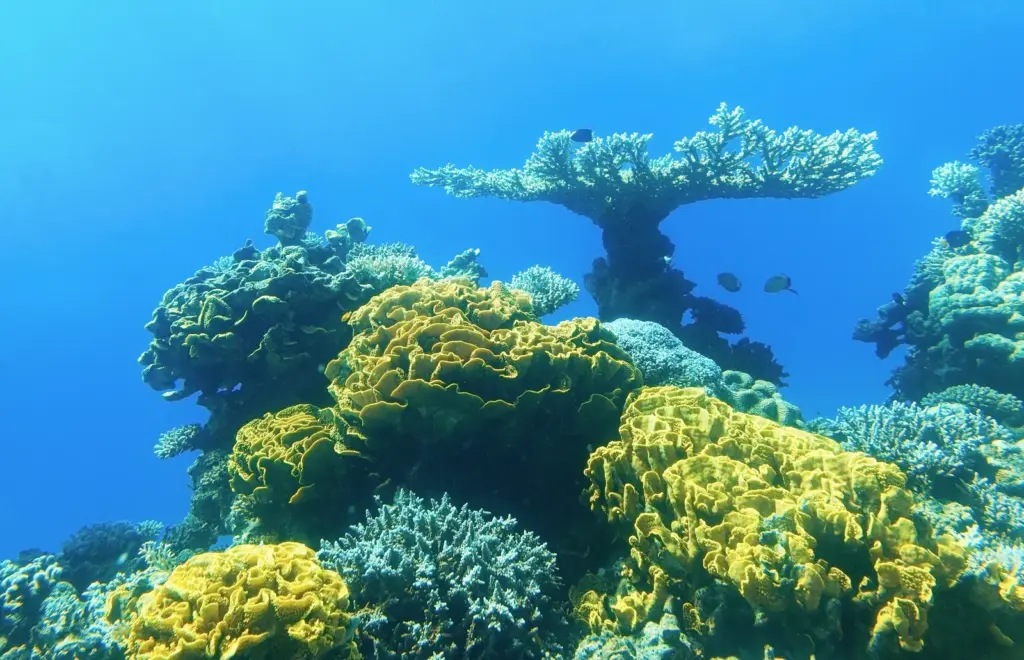
Reef fish move through these coral gardens in busy layers, from small damsels and anthias to jacks and occasional trevally. The drop-offs are the real draw for many divers, where the reef edge falls away into deep blue and larger pelagic shapes appear without warning. Visibility varies with tide and plankton, but the sheltered fjords often hold clear water even when the open sea is rough. Currents are usually gentle, making the sites suitable for a broad range of experience levels.
Rays are among the most memorable encounters. Spotted eagle rays glide over the sand with slow wingbeats, their backs covered in pale spots, and can reach a wingspan of up to ten feet. They are listed under CITES and protected from fishing in the UAE, a reminder that these waters are shared with species under real pressure. Cownose rays are smaller, around three feet long, with a distinctive forehead that gives them their name. Both species move with a grace that makes even a short sighting linger long after the dive.
Planning a longer dhow trip
For divers who want more than a single day, liveaboard-style dhow trips offer a different rhythm. A two-night, two-day schedule gives time for six guided dives with tanks, weights and dive tax included, and nitrox is available for certified divers. Cabins are air-conditioned, often with two single beds in each, and the galley runs on a full-board basis. Non-divers and snorkelers can join the same trip, which makes it workable for mixed groups.
The overnight pattern changes the experience completely. Evenings are spent on deck under the stars, with the mountains dark against the sky and the water slapping gently against the hull. Mornings begin with a dive before the day boats arrive, when the reefs are quiet and the light is still low. This is when Musandam feels most remote, even though the border is only a few hours from the city.
The practical details matter here. A typical shared liveaboard package includes the dhow, cabin, meals, guided dives, tanks, weights and dive tax, but you should confirm what is covered before booking. Some trips run on fixed dates through the season, such as early October and late November, so planning ahead helps. Bring a reusable water bottle, a warm layer for evenings, and a small head torch for moving around the deck after dark.
What to pack for a dhow dive day
Packing well makes the difference between a comfortable day and a long one. The boat provides shade, but the sun reflects hard off the water, so a long-sleeved rash vest and high-factor sunscreen are essential. A wide-brimmed hat stays useful between dives, and polarised sunglasses cut the glare when you are scanning for dolphins or watching the cliffs. Most operators provide the core dive kit, including BCD, regulator, wetsuit, mask, fins, weight belt and tanks, but many divers prefer their own mask and computer.
Sea sickness is worth planning for even in sheltered fjords, especially on the open approach. A light breakfast and medication taken before departure can help, but check with a medical professional about what suits you. Keep a dry bag with a towel, a change of clothes and any medication close at hand. The deck can be slippery, so footwear with grip is more useful than flip-flops once the boat is moving.
The following list covers the essentials without overloading your bag. A traditional dhow carries you past the Hajar Mountains, which form a dramatic backdrop of fjords and emerald bays. Once aboard, you can enjoy a full-day trip or an overnight liveaboard experience with guided dives. Beneath the surface, colorful corals like brain corals and purple whip corals thrive in these warm waters. Graceful spotted eagle rays and distinctive cownose rays are among the remarkable marine life you may encounter here.
- Passport and any border paperwork, kept in a waterproof pouch and checked before you leave home.
- High-factor sunscreen and lip balm, reapplied after every dive because water and wind strip protection quickly.
- A wide-brimmed hat and polarised sunglasses for surface intervals and the long ride back to harbour.
- A dry bag with a towel, warm layer and spare clothes, because the afternoon breeze can feel cool on wet skin.
- Your own mask, snorkel and dive computer if you have them, even when rental gear is included.
- Sea sickness medication if you are prone to motion discomfort, taken according to medical advice.
- A reusable water bottle and small snacks, since staying hydrated between dives matters more than most people expect.
Once the boat ties up and the kit is rinsed, the day ends much as it began, with the mountains drawing the eye and the water settling into its evening colour. The drive back to the border gives you time to replay the dives, the rays, the coral and the long quiet hours between them. Musandam by dhow is not a high-speed adventure. That is precisely why it works.
The rhythm of an overnight on board
Staying overnight on a dhow rearranges your sense of time. After the day boats leave, the fjord empties out and the only sounds are the water, the generator and the occasional call of a seabird. Dinner is served on deck, often grilled fish or meat with rice and salad, and the conversation drifts between dive stories and long silences. The cabins are simple but comfortable, with air conditioning and narrow beds that feel surprisingly good after a full day in the water.
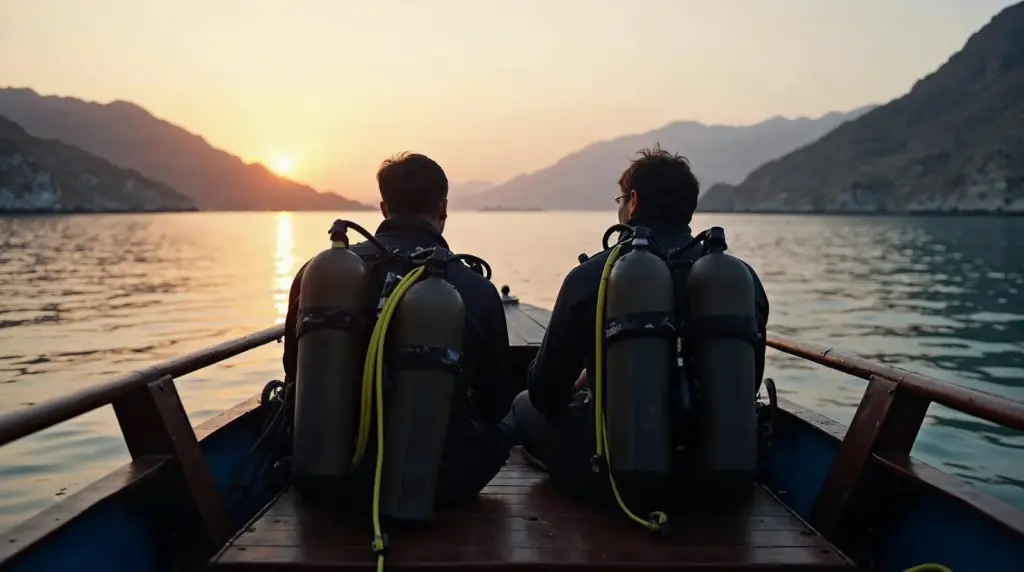
Morning comes early, with tea and coffee before the first dive. The water is often glassy at that hour, and the reefs have a different energy before the sun climbs high. A second dive follows breakfast, then the boat begins the slow return through the fjords. By the time you reach the harbour, the mountains have shifted from shadow to full sun, and the weekend already feels longer than it was.
Choosing your diving route and dates
Musandam’s dive sites are spread across several islands and inlets, and the route often depends on weather, tides and the operator’s plan for the day. Abu Sir Island and Al Khayal Island are common first stops, with shallow coral gardens and easy entries. Bu Rashid Island and Khor Farda offer variety, from sandy slopes to small walls. The sheltered nature of the fjords means trips can run year-round, though summer heat and winter winds shape the comfort level.